Day 21 – How Turkey Became a Christmas Food
“The eyes of all wait upon thee; and thou givest them their meat in due season.” Psalm 145:15
By 1720, there were about 250,000 turkeys being farmed every year in Norfolk (on the east coast of England). As well as coming via the country of Turkey, turkeys also came into England from The Netherlands via Spanish and Portuguese traders who had strong historical ties with The Netherlands.
Before turkeys could travel by train, they had to be walked from the farms to the markets. This could take weeks, with the farmers and the birds having to camp each night at the side of roads. The feet of the birds were often dipped in tar to act like ‘feet tires’ to stop them getting sore. In England they would walk from Norfolk down to London and were only eaten by the rich at this time.
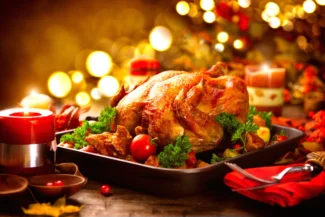
Turkeys became ‘fashionable’ to eat for Christmas in England in the 1840s and 1850s. In ‘A Christmas Carol’ by Charles Dickens,’ which was published in 1843, the Cratchit family first had a goose, but at the end of the book Ebenezer Scrooge gives them a turkey. Dickens’s family are also recorded having a turkey for Christmas in 1843!
Queen Victoria first had a turkey at Christmas in 1851. In the 1861 book “Mrs. Beeton’s Book of Household Management”, turkey was praised as the Christmas meal for the growing middle classes and the book even included instructions on how to carve them correctly.
With the trains system growing towards the end of the 1800s meant that turkeys could be moved much more quickly around the country. But it wasn’t until after WWII, when farming became more efficient and so food cheaper, that turkey became the ‘traditional’ Christmas meal in England, rather than beef or goose.
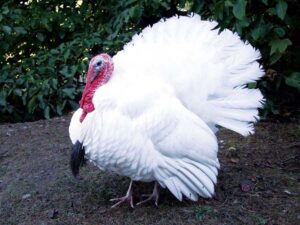
Most commercially grown turkeys are now the ‘White Holland’ variety which was first breed in The Netherlands.
“Take no thought for your life, what ye shall eat, or what ye shall drink…” Matthew 6:25